The WHO Framework Convention on Tobacco Control (WHO FCTC) has helped drive enormous progress on tobacco control throughout the world, since being introduced 20 years ago.
But even though more than 90% of the world’s population is now covered by the WHO FCTC, smoking still kills eight million people each year.
To meet this challenge, we need accelerated action. That’s where the Convention Secretariat’s Knowledge Hubs come in, providing support and guidance to parties in implementing the measures contained in the treaty.
Representatives from eight Knowledge Hubs around the world gathered in Helsinki, Finland in September 2023 to share information and find innovative ways to collaborate as we work together towards a tobacco-free future.
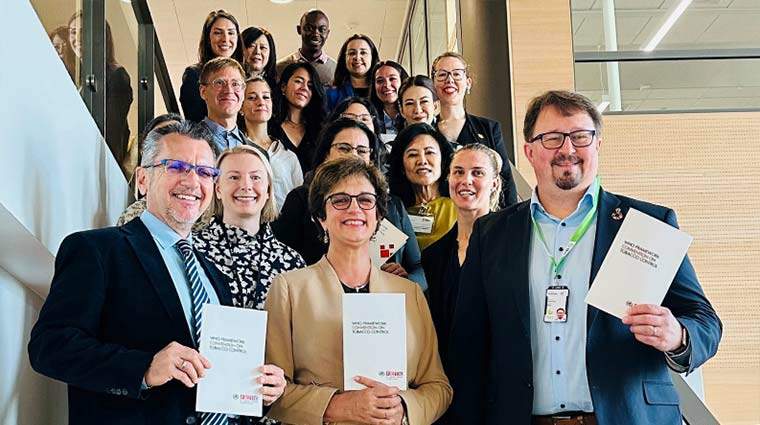
Hayley Jones and Suzanne Zhou representing the Knowledge Hub on Legal Challenges, hosted by the McCabe Centre for Law and Cancer, joined colleagues from Knowledge Hubs from Africa, Asia, the Middle East, South America and Europe, united in the aim to support Parties to the WHO FCTC to fully implement the Convention.
The meeting, hosted by the Knowledge Hub on Surveillance, at the Finnish Institute for Health and Welfare, was the first in-person convening since 2019, and brought together experts on issues from industry interference to surveillance, to waterpipes and smokeless tobacco.
Head of the Convention Secretariat Dr Adriana Blanca Marquizo,joined the three-day meeting, which provided rich opportunities to share experiences, to learn more about other Knowledge Hubs and their work plans and to consider how Knowledge Hubs can make their work truly global.
The meeting included celebrations of the newest Knowledge Hubs to be established. Most recent is the Knowledge Hub hosted by Santé publique France, focused on public awareness in relation to Article 12 of WHO FCTC, which requires Parties to promote and strengthen public awareness of tobacco control issues, using all available communication tools, as appropriate. Such evidence-based public communications are more important than ever in an era of mis- and dis-information on social media.
The Knowledge Hub on Articles 17 and 18, located at the Oswaldo Cruz Foundation (Fiocruz) in Brazil, has also been busy since it was designated in 2020. With its focus on alternative livelihoods for tobacco farmers and workers, the Hub had a particularly successful campaign for this year’s World No Tobacco Day, with the focus on 'Grow Food, Not Tobacco'.
For all Knowledge Hubs, tobacco industry interference remains the biggest threat to action on tobacco control worldwide. Professor Nuntavarn Vichit-Vadakan, Director of the Knowledge Hub on Article 5.3, led a productive day of reflective group activities during the three-day meeting identifying gaps and opportunities for collaboration.
Zunda Chisha, Programme Director of the Knowledge Hub on Tobacco Taxation at the University of Cape Town located in South Africa, commented:
“These collaboration meetings exemplify the spirit of international cooperation in the pursuit of global health objectives. We eagerly anticipate further discussions and collective efforts to advance public health and tobacco control.”
The upcoming Conference of the Parties to the WHO FCTC, to be held in Panama in November 2023, was also a key item of discussion at the meeting. The Knowledge Hubs agreed to collaborate on a side event showcasing their key activities and opportunities for parties to access support, and will also host a booth to provide further information.
Hayley Jones, Director of the Knowledge Hub on Legal Challenges, said:
“Knowledge Hubs play a valuable role in supporting implementation of the WHO FCTC and have already made a tangible impact on tobacco control around the world. But there is much more that we can do together. Exchanging experiences with the other Knowledge Hubs has given us some fresh ideas about how we can collectively support parties in fully implementing the WHO FCTC, and raise awareness on how to better protect it from legal challenge.”
To learn more about the work of the Knowledge Hubs, please visit: https://extranet.who.int/fctcapps/fctcapps/fctc/kh