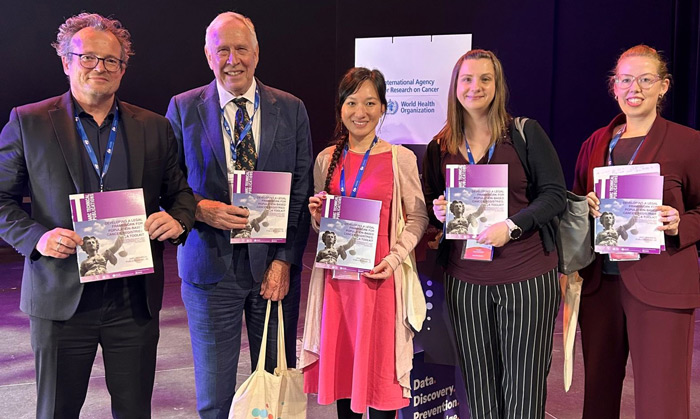
Our Director, Hayley Jones, attended the IARC@60 conference in Lyon this week, where the new Legal Framework for Cancer Registries Toolkit was officially presented, marking an important step forward in supporting countries to build and strengthen population-based cancer registries. The toolkit was developed by the McCabe Centre for Law & Cancer, in collaboration with the International Agency for Research on Cancer (IARC) and the African Cancer Registry Network (AFCRN).
Currently, only 21% of the world’s population is covered by such registries, highlighting a significant gap in the availability of high-quality cancer data. Robust legal frameworks are critical to addressing this gap. They enable mandatory reporting, support timely and systematic data collection, and ensure strong privacy protections, all of which are essential for producing reliable data that can guide cancer control efforts and reduce inequities.
Drawing on global legal analysis and expert input, the toolkit offers a practical and adaptable resource for countries seeking to establish or enhance cancer registry systems. Recognising that there is no one-size-fits-all solution, the toolkit provides flexible legal approaches tailored to different national contexts, while aligning with international best practices. By strengthening legal foundations, it aims to support more consistent, high-quality cancer data collection worldwide.
The project brought together a broad international collaboration, developed by Sondra Davoren, Ma-Anne Rosales-Sto. Domingo, Rachel Kitonyo, Hayley Jones (McCabe Centre), Freddie Bray (IARC), Max Parkin and Biying Liu (AFCRN), and Magdalena Paczkowski at Vital Strategies.
The toolkit is now publicly available and can be accessed online – see here.
A webinar will be hosted later this year to introduce the toolkit and demonstrate how it can be applied in practice. Ongoing dissemination and feedback will support further refinement, with the ultimate goal of strengthening cancer registry systems globally and advancing health equity.